Innovation for Sustainable Development for Olderprenure
- Summary
- Mobility Details
- Inclusion
- Innovation Element
- Impact
This TRAIL pilot mobility was designed to promote active ageing, social participation, and European belonging among older adults by engaging them in an international learning experience. From 14–17 April 2025, five older German learners (aged 65+) participated in a KA1 mobility course in Thessaloniki, Greece, titled “Innovation for Sustainable Development.” The course used a Design-Based Collaborative Learning (DBCL) approach and brought together participants from across Europe, including university students from Serbia, Portugal, Italy, Greece, and Germany.
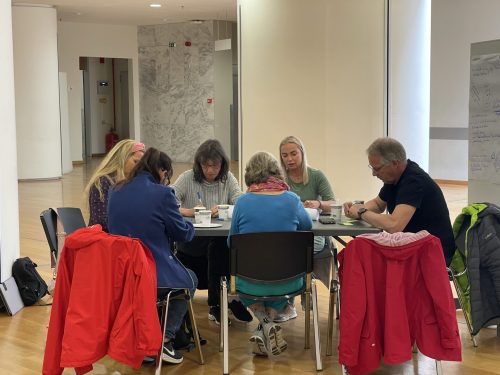
While the older participants worked in their own group rather than being integrated into the student DBCL teams, they participated fully in the joint elements of the programme: shared input sessions, feedback rounds, group discussions, social dinners, and cultural exchanges. These touchpoints were carefully designed to foster intergenerational dialogue and mutual recognition. For example, during team presentations, all groups — including the seniors — received questions and comments from the student teams, encouraging respectful exchange and valuing the seniors’ insights and perspectives.
The course followed the full cycle of design thinking: empathise, define, ideate, prototype, and present — all framed around the UN Sustainable Development Goals (SDGs). Within this structure, the senior group explored their own sustainability challenge and developed a team response, culminating in a final presentation delivered to all participants.
The pilot was designed as an inclusive learning mobility experience under TRAIL to examine how older adults with limited prior mobility experience — due to language barriers, health limitations, or digital confidence — can meaningfully engage in international, intercultural learning experiences. The results demonstrate that, with appropriate support, older learners can participate successfully in European mobility projects, reinforcing their sense of connection to European values, their civic contribution, and their role as lifelong learners.
Target Group: Seniors, aged 65 to 85.
Sending Country: Germany
Hosting Country: Greece
Duration: 4 days
Challenge to Inclusion:
- Limited English proficiency: Most participants were not confident using English in an academic or intercultural setting.
- Digital unfamiliarity: Learners had little experience with digital tools like Canva or online collaboration platforms.
- Physical and cognitive ageing factors: Participants required slower pacing, rest breaks, and simplified materials to stay engaged.
- Low confidence in new environments: Traveling abroad, joining a university course, and interacting with younger learners created anxiety and uncertainty.
- Social and generational barriers: The course included university students from multiple European countries, making intergenerational interaction both a challenge and an opportunity.
Solution to Inclusion
- Need for flexible pacing and reduced cognitive load → Afternoon sessions were lighter; breaks were flexible; visual and printed materials replaced text-heavy instructions.
- Limited English proficiency → A bilingual mentor provided real-time interpretation and simplified summaries.
- Need to feel welcome and valued → Shared meals, group feedback rounds, and social events facilitated intergenerational interaction.
- Need for comfort and orientation → Low-barrier venues, slow-paced transitions, and access to quiet spaces ensured physical comfort.
- Need for reassurance and confidence-building → Daily check-ins, reflection sessions, and constant mentor presence helped learners feel supported.
- Anxiety around travel planning → All logistics (travel, accommodation, transfers) were handled by the sending organisation, creating security.
- Low familiarity with digital tools →
Facilitators guided learners through visual tools and removed pressure to use technology independently.
- Intergenerational collaboration within a design-thinking framework: Seniors worked alongside European university students on sustainability topics, fostering two-way learning between generations.
- Application of the DBCL (Design-Based Collaborative Learning) method: The structured, creative learning approach — typically used in higher education — was successfully adapted for older learners.
- Integration of LEVEL5 competence validation: Learners reflected on their growth in knowledge, skills, and attitudes in areas such as inclusion, sustainability, and collaboration.
- Flexible and empathic facilitation: The course blended structure and openness — learners could choose their pace and method of participation, reflecting universal design for learning principles.
- Intentional intergenerational inclusion design: Activities like shared presentations, feedback rounds, and cultural dinners were strategically used to bridge the age gap and promote equal participation.
Observed outcomes:
- All five senior participants completed the full programme and actively engaged in all activities.
- Learners developed stronger confidence, intercultural communication, and team collaboration skills.
- Participants reported feeling empowered and valued, realizing that their life experience contributed meaningfully to the group.
- The mobility helped them see themselves as European learners and contributors, not as passive recipients.
- Feedback was overwhelmingly positive — learners felt “safe, supported, and inspired to keep learning.”
Foreseeable impact:
- Increased lifelong learning motivation and participation of older adults in future Erasmus+ opportunities.
- A replicable model for age-inclusive mobility, showing that seniors can engage in DBCL and sustainability-focused projects.
- Stronger intergenerational solidarity and European identity through shared learning experiences.
- Enhanced awareness among partner organisations (blinc eG and AUTh) about how to adapt traditional academic structures to be more inclusive.