
Didactic Development of Inclusive Mobility Learning Formats
This module focuses on the design, plan and delivery of mobility activities suiting the learning needs of adult learners coming from different backgrounds. Effective didactic development is essential for fostering an inclusive learning environment that ensures equal opportunities for all participants. This module provides a comprehensive framework for assessing learners needs, designing inclusive mobility activities, and implementing effective and inclusive teaching methods.
- Onboarding
- Bringing with You
- Travellers Tips
- Activities
- Resources
This module aims to equip adult trainers with the knowledge and skills necessary to design, implement, and adapt mobility learning activities that cater to diverse adult learners. It addresses the critical need for accessible and effective learning experiences within inclusive mobility programs.
You will gain a comprehensive understanding of:
- How to assess and address learners’ needs to ensure meaningful participation.
- Strategies for designing inclusive mobility activities that support diverse learning styles and backgrounds.
- Effective and inclusive teaching methodologies that enhance engagement, accessibility, and learning outcomes.
By the end of this unit, you will be able to create learner-centered mobility experiences that foster equal opportunities and empower adult learners in diverse contexts.
A learning need is the gap that exists between current practices and desired practices. In order to design effective and inclusive mobility learning offers for adult learners from different backgrounds, we need to understand their learning needs.
How to conduct a learning needs assessment?
Understanding the diverse learning needs of adult learners is essential for creating effective educational experiences.
Step 1: Define and prioritize your objectives – What do we want to achieve? Clearly establish the intended learning outcomes for the mobility activity. What specific knowledge, skills, and attitudes should the learner develop?
Step 2: Choose appropriate assessment method – Select a combination of assessment methods to cater to different learning styles and needs: surveys, interviews, observation … (check in module: Evaluation and Validation).
Step 3: Analyse data – You’ll want to be on the lookout for patterns and trends that will help you pinpoint the most significant skill gaps and areas where knowledge needs to be improved (ex. skill sets, experience levels, knowledge gaps, learning preferences).
Step 4: Recommend learning solutions – Based on the data gathered, build unique training paths that address the specific needs of each learner.
Step 5: Measure progress – By continuing to gather this data, you’ll gain valuable insights that can help you continuously fine-tune your learning initiatives
Designing mobility activities with the SMART method
Goals are part of every aspect of life and provide a sense of direction, motivation, a clear focus, and clarify importance. Establishing SMART goals ensures that mobility learning objectives align with adult learners’ needs.
SMART goals are:
- Specific: Well defined, clear, and unambiguous
- Measurable: With specific criteria that measure your progress toward the accomplishment of the goal
- Achievable: Attainable and not impossible to achieve
- Realistic: Within reach, realistic, and relevant to your life purpose
- Timely: With a clearly defined timeline, including a starting date and a target date.
To boost motivation, it’s important to set short-term, achievable goals that allow learners to experience success early on, building confidence and engagement.
LEVEL5 is a:
- taxonomic system for Competence Oriented Learning and Validation.
- long-term validation system to assess and validate competence developments in informal and non-formal learning settings.
It is based on a three-dimensional model which maps the development of knowledge (cognitions), skills (actions) and attitudes (emotions and values) along five quality levels – from beginner to competent expert.
This taxonomy helps trainers assess, document, and plan competence developments in highly context-dependent environments such as learning in mobility for people from different backgrounds.
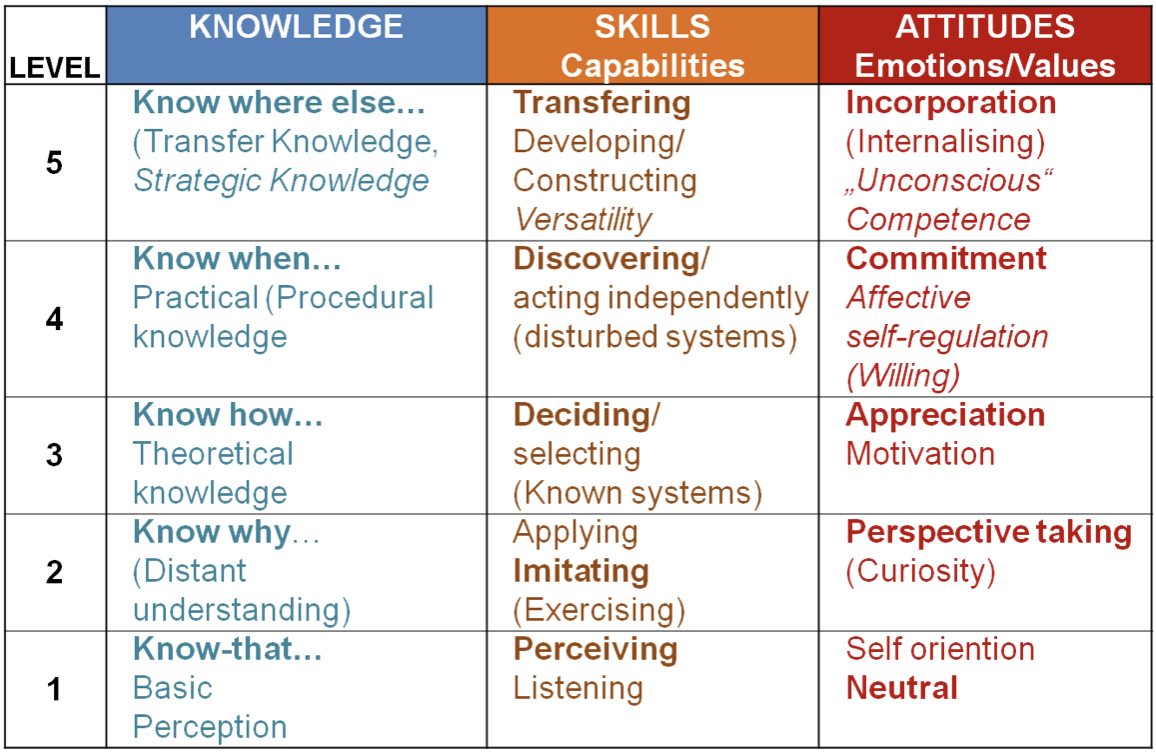
By assessing knowledge, skills, and attitudes, LEVEL5 enables trainers to design tailored mobility activities that match learners’ needs and backgrounds, creating a demand-driven and meaningful learning experience.
Inclusive teaching refers to pedagogy that strives to serve the needs of all learners, regardless of background or identity, and support their engagement with subject material.
Inclusive teaching methods are essential for creating equitable learning environments. This chapter discusses three strategies that trainers can implement to support diverse learners effectively.
Three inclusive teaching strategies:
- Teamwork at ALL levels: involve social workers, psychologists, personal assistants, or rehabilitation therapists into creating optimal learning conditions in an inclusive mobility learning offer.
- Put emphasis on personal strengths: Inclusive education should concentrate on teaching learners not to compensate for their “deficiencies”, but instead to value their strengths.
- Practice “Scaffolding”: Scaffolding is a process that enables learners to solve a problem, complete a task, or achieve a goal that is beyond their individual efforts or capabilities. This technique relies on the trainer’s help and support.
No matter what methods the trainer uses, it is important to convey: a person cannot be judged only by the lack of something. Even abilities and achievements are important contributions to the life of the course, but they cannot measure the value of a person. Because inclusion is when everyone matters.
- Sending organisation
- Hosting organisation
- The Traveller (learner)
Didactic development ensures that mobility activities are not only accessible but genuinely meaningful. Inclusive planning requires a clear understanding of learners’ needs, strengths, and learning preferences, followed by structured methods for designing activities that support participation and competence development.
Traveller Tips
• Begin with a structured learning needs assessment. Information on learning styles, confidence levels, functional barriers, and past experiences guides the design of effective activities.
• Prioritise realistic learning objectives. Overly ambitious goals can create frustration, while well-targeted ones support engagement and motivation.
• Apply the SMART method to define learning outcomes—specific, measurable, achievable, realistic, and time-bound.
• Use LEVEL5 to plan competence development in knowledge, skills, and attitudes. This helps visualise progress and ensures a balanced learning offer.
• Design activities that value personal strengths. Adults from diverse backgrounds engage more fully when their lived experience is recognised.
• Ensure scaffolding is built into each activity. Step-by-step guidance or gradual task complexity helps build autonomy without overwhelming the learner.
• Collaborate with support professionals—social workers, psychologists, or assistants—when specific needs require tailored guidance.
Potential applications
• Develop simple learner personas to guide activity planning.
• Use a needs-assessment grid before drafting the programme.
• Break activities into small, achievable stages to avoid overload.
• Apply LEVEL5 descriptors to shape learning outcomes for mobility.
Hosts translate didactic planning into lived experience. The way activities are run affects participation, confidence, and learning outcomes for disadvantaged adults. Inclusive didactics support learners in navigating unfamiliar environments and varied group dynamics.
Traveller Tips
• Facilitate activities in ways that accommodate multiple learning styles—visual, verbal, hands-on, cooperative.
• Adapt teaching speed and complexity to the group’s comfort level. Adults with fewer opportunities may need more processing time or simplified instructions.
• Provide clear structure. Predictable sequences help individuals with cognitive or emotional barriers feel anchored.
• Integrate reflective moments. Short debriefs allow learners to consolidate new knowledge and recognise personal progress.
• Ensure teamwork is equitable. Mixed-ability groups often flourish when roles are varied and strengths-based.
• Create a low-pressure environment. Emphasis on learning rather than performance strengthens motivation.
• Maintain flexibility. If an activity proves too demanding, alternative pathways or additional scaffolding should be introduced.
Potential applications
• Use visual task boards to support attention and orientation.
• Facilitate group work where responsibilities are shared.
• Include short reflection cards or icons at the end of sessions.
• Combine structured learning with practical, experience-based tasks.
Inclusive learning formats aim to make participation meaningful, accessible, and confidence-building. When activities align with individual strengths and needs, learning becomes more enjoyable and progress becomes more visible.
Traveller Tips
• Learning activities are designed to accommodate different ways of engaging—practical, reflective, visual, or discussion-based.
• Support is available through scaffolding, step-by-step guidance, and adapted pacing.
• Strengths and previous experiences are valuable contributions to group learning.
• Goals are planned to be realistic and reachable, helping maintain motivation and a sense of achievement.
• Reflections and small check-ins help highlight personal progress and identify areas where extra support may be helpful.
• Group work fosters shared learning, mutual encouragement, and a sense of belonging.
• Learners influence the learning process through feedback, preferences, and participation.
Potential applications
• Keep a simple progress log or reflection sheet to notice learning gains.
• Participate in group discussions or small practical tasks based on comfort and strengths.
• Use visual supports or checklists during activities to stay oriented.
• Discuss preferred learning approaches (e.g., hands-on tasks, visual examples) during initial sessions.
Activities
For whom: Adult trainers
Objective: To practice and refine the skills needed to conduct learning needs assessments for diverse adult learners.
Instructions:
- Divide trainers into small groups to facilitate interactive role play.
- Assign each group a specific learner profile (e.g., senior with mobility limitations, adult with autism, person with a visual impairment).
- Each group role-plays a needs assessment scenario, utilizing the assessment methods discussed in the chapter (surveys, interviews, observations).
- After the role-play, each group shares their identified learning needs, recommended learning solutions.
- The larger group discusses the challenges encountered during the simulation and strategies for overcoming them.
For whom: Adult learners
Objective: To empower adult learners from different background to self-assess their learning needs and set achievable goals for mobility training.
Instructions:
- Provide learners with a simplified self-assessment tool that covers various aspects of mobility (e.g., physical abilities, knowledge of transportation options, confidence in navigating unfamiliar environments).
- Guide learners through the self-assessment process, providing support and clarification as needed.
- Based on the results of the self-assessment, work with each learner to set 1-2 SMART goals for mobility training.
- Develop a personalized action plan for achieving these goals, including specific activities and timelines.
- Encourage learners to track their progress and celebrate their achievements.
Take the Quiz!
LEVEL5 Competence Taxonomy
https://level5.eu/level5-competence-taxonomy/
Taylor Cole, Learning Needs Assessment – Your guide to conducting a learning needs assessment.
Your guide to conducting a learning needs assessment
Simon Bell, SMART goals
https://www.mindtools.com/a4wo118/smart-goals
Yale Poorvu Center for Teaching and Learning, Inclusive teaching strategies
https://poorvucenter.yale.edu/InclusiveTeachingStrategies